
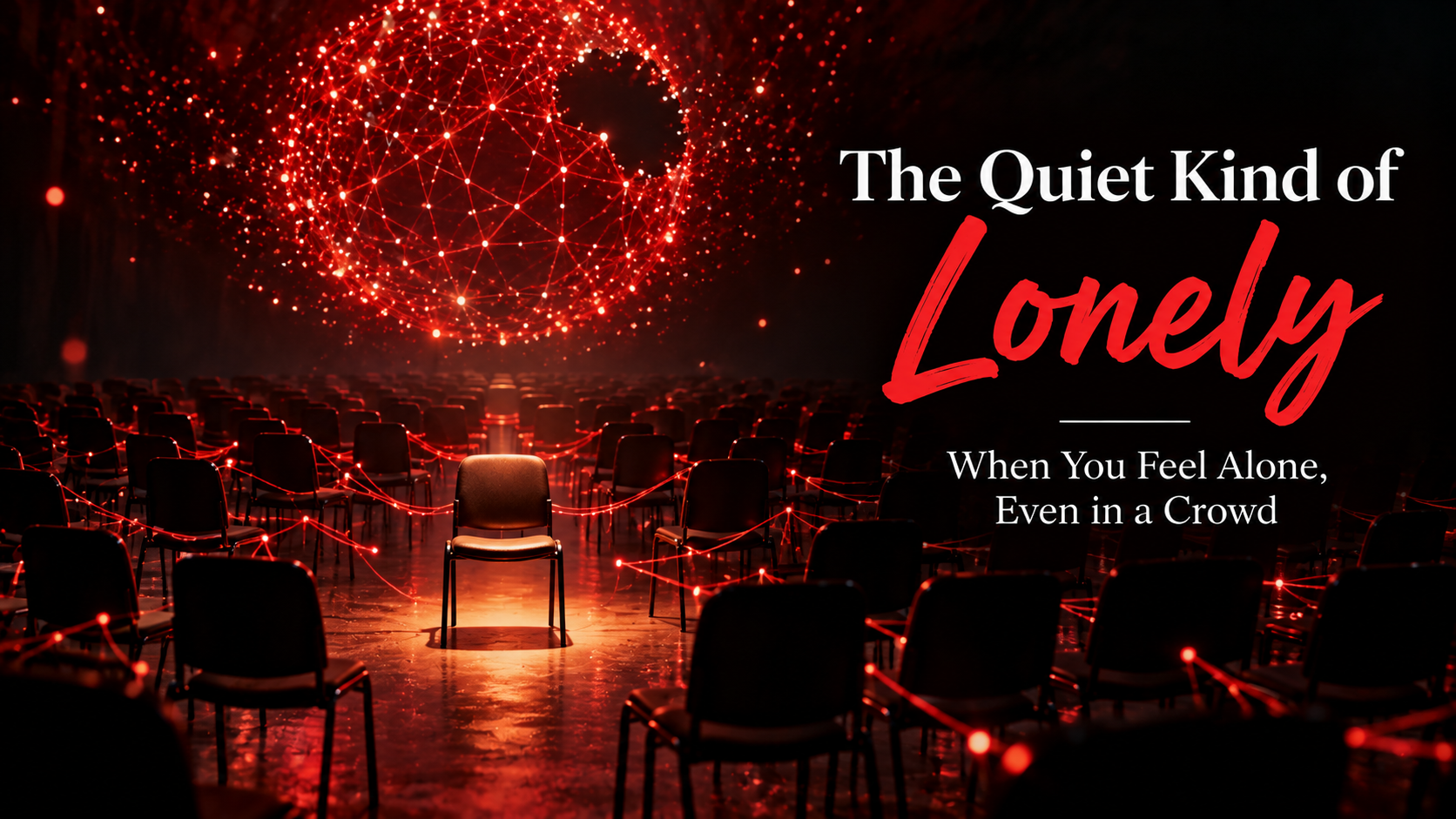
When people think about loneliness, they often imagine being completely alone.
No friends.
No family.
No one to talk to.
But loneliness doesn't always look like an empty room.
Sometimes, loneliness looks like sitting in a room full of people and still feeling disconnected.
It can look like having friends but feeling like no one really knows you.
It can look like having people around you but not feeling comfortable enough to tell them what you're actually going through.
It can look like scrolling through hundreds of posts and still feeling like you have no one to call.
Loneliness isn't always about the number of people in your life.
Sometimes, it's about the quality of connection you feel.
There is also a difference between being alone and feeling lonely.
Being alone can be peaceful.
It can give you space to rest, think, create, recharge, or simply enjoy your own company.
Loneliness is different.
Loneliness can feel like wanting connection and not knowing where to find it.
For some people, loneliness can happen after a major life change.
A move.
A breakup.
Starting a new school.
Losing a friendship.
Leaving a job.
Becoming a parent.
Going through grief.
Even entering a new season of life can create distance between who you were surrounded by before and who is around you now.
And sometimes loneliness happens even when nothing obvious has changed.
You can feel lonely because you don't feel understood.
You can feel lonely because you're afraid to be vulnerable.
You can feel lonely because you've been giving so much to other people that you haven't made space for meaningful connection with yourself or anyone else.
Loneliness can also make it tempting to withdraw even more.
You might think:
“Nobody would understand anyway.”
“I'll just stay home.”
“I don't want to bother anyone.”
“It doesn't matter.”
But isolation can sometimes make loneliness feel even heavier.
Connection doesn't always require a huge social circle.
Sometimes it starts with one person.
One honest conversation.
One invitation.
One text message.
One community.
One place where you don't feel like you have to perform.
And sometimes, creating connection means taking a small risk.
Sending the message.
Joining the group.
Going to the event.
Calling the friend.
Telling someone, “I've been feeling lonely lately.”
You don't have to pretend you're okay just because you're surrounded by people.
And you don't have to be surrounded by people every moment to have a meaningful relationship with yourself.
There is nothing shameful about wanting connection.
Humans need connection.
We need people who can celebrate with us, listen to us, challenge us, support us, and remind us that we matter.
If loneliness has become persistent, overwhelming, or is affecting your ability to function, talking with a mental health professional can also be a meaningful step.
You don't have to wait until loneliness becomes unbearable before reaching out.
Sometimes the first step isn't finding a hundred people.
Sometimes it's simply letting one person know how you've been feeling.
Let this be a reminder:
Feeling lonely does not mean you are unwanted, forgotten, or destined to feel this way forever. Sometimes the first step toward connection is simply letting someone know you need it.
